
Metadata
- Author: Marius Orcsik
- Status: In-Progress
- URL: https://go-activitypub.federated.id/lib/rfc
Objective
The main purpose of this document is to establish the final API for version 1.0 of the library.
This includes the main modules of the GoActivityPub library:
There are a couple of other modules, but their importance is secondary and will most likely not be included in what we consider v1.0.
Background
Since its inception the GoActivityPub library developed has been driven by a continuous loop of assessing the specifications it builds on, then develop functionality around them and then using the resulting features in reference applications to eventually expose incompatibilities or rough edges.
We’re finally in a place where this loop has run enough times so there are no more obvious places that require new functionality, and we can focus on unifying the existing elements into a robust and polished version.
We want to signal this to the developers that use the library by tagging a stable version.
Goals
The main goal is a global restructuring of the library modules. This needs to be done because functionality has shifted between them, some have been simplified to the point that they don’t make sense independently, and some of them can be consolidated into a single unit.
This is the top level view of the plan:
- The
activitypubmodule will be renamed tovocab(or perhapslexicon) and contain the vanilla types described in the Activity Vocabulary specification. - The
processingmodule will become the newactivitypubmodule, and it will contain the state machine for processing client to server and server to server activities.- It will include sub-packages for convenience functionality to provide better interoperation with the wider Go ecosystem: HTTP handlers and middleware
- The
authmodule moves as a sub-package here. Now that theosinserver has been removed, maybe we can even rename it to something else. Its main function currently is to load from various authorization headers the correspondingActorentities.
- The
clientmodule mostly stays as it is. Perhaps we will move the OAuth2 and HTTP-Signatures functionality to the authorization module.- Another option is to move it as a sub-package of
processing. - Yet another option is to move the verification mechanisms for OAuth2 and HTTP-Signatures in here, instead of the
processingmodule.
- Another option is to move it as a sub-package of
- Add
context.Contextarguments to functions and methods:- Inject opentelemetry context
- Support canceling the storage backends methods
- Support canceling the Processing methods and functions
Non-Goals
A very large part of making the GoActivityPub library compatible with the wider Fediverse is to allow for highly dynamic Activity Vocabulary objects.
As this contradicts the “statically typedness” of the Go programming language and the specific goal of the library to provide data types identical with their on the wire representation, the solution is to build a code generation tool that can build these dynamic types at compile time based on their JSON-LD context documents.
This code generation tool is not going to be part of version 1.0 of the GoActivityPub library. A separate document will be created for it at a later date, ideally after all the goals of this document have been reached.
We consider that all the work done under this RFC is a way to smooth the way for this future step.
We have started documenting the requirements for this future RFC.
Processing activity methods
We want the processing of activities be cancelable and be capable of adding telemetry details, so we need to accept a context argument.
 ProcessActivity(it vocab.Item, author vocab.Actor, receivedIn vocab.IRI) (vocab.Item, error)
 // becomes
 ProcessActivity(ctx context.Context, it vocab.Item, author vocab.Actor, receivedIn vocab.IRI) (vocab.Item, error)
Additionally the processing.Store interface will receive a context so that the implementations can cancel storage operations.
type Store interface {
	// Load returns an Item or an ItemCollection from an IRI
	// after filtering it through the FilterFn list of filtering functions. Eg ANY()
	Load(vocab.IRI, ...filters.Check) (vocab.Item, error)

	// Save saves the incoming vocabulary Object, and returns it together with any properties
	// populated by the method's side effects. (eg, Published property can point to the current time, etc.).
	Save(vocab.Item) (vocab.Item, error)
	// Delete completely deletes from storage the vocabulary Object, this is usually
	// a side effect of an Undo activity.
	Delete(vocab.Item) error

	// AddTo adds "it" element to the "col" collection.
	AddTo(vocab.IRI, ...vocab.Item) error
	// RemoveFrom removes "it" item from "col" collection
	RemoveFrom(vocab.IRI, ...vocab.Item) error
}
// becomes

type Store interface {
	// Load returns an Item or an ItemCollection from an IRI
	// after filtering it through the FilterFn list of filtering functions. Eg ANY()
	Load(context.Context, vocab.IRI, ...filters.Check) (vocab.Item, error)

	// Save saves the incoming vocabulary Object, and returns it together with any properties
	// populated by the method's side effects. (eg, Published property can point to the current time, etc.).
	// TODO(marius): ⚠ we want to be able to delete multiple items !!!
	Save(context.Context, vocab.Item) (vocab.Item, error)
	// Delete completely deletes from storage the vocabulary Object, this is usually
	// a side effect of an Undo activity.
	// TODO(marius): ⚠ we want to be able to delete multiple items !!!
	Delete(context.Context, vocab.Item) error

	// AddTo adds "it" element to the "col" collection.
	AddTo(context.Context, vocab.IRI, ...vocab.Item) error
	// RemoveFrom removes "it" item from "col" collection
	RemoveFrom(context.Context, vocab.IRI, ...vocab.Item) error
}
The way we want this to be used is similar to the example in this slide:
func (s *store) Load(ctx context.Context, iri vocab.IRI, f ...filters.Check) (vocab.Item, error) {
	ctx, cancel := context.WithCancel(ctx)
	defer cancel()

	c := make(chan vocab.Item)
	go s.asyncLoad(c, iri, f...)

	select {
	case <-ctx.Done():
		return nil, ctx.Err()
	case it := <-c:
		return it, nil
	}
	return nil, errors.New()
}
Collection dissemination
Another important piece of logic that the processing module has to streamline is the aggregation of collections to which objects and activities need to be disseminated to:
- For objects: local replyTo collections
- For activities: local followers collection members
- For activities: actors that use the same shared inbox
General module rules
When applicable, each module needs to have a single main data type that operates on, this is not entirely idiomatic with the Go language suggestion of keeping everything related in the same package.
lexicon: types for the vanilla Activity Vocabulary with corresponding utility functions.activitypub: split dereferencer, validator, processor functionality.client: will hold thehttp.Clientwrapper. It can retain the sub-packages for the OAuth2 and HTTP-Signatures transports.auth: will hold the OAuth2 and HTTP-Signatures verifiers.
The initializer can return un-exported data types.
The initializer functions have two patterns: WithXXX if they supply a value, or VerbDoingThing for setting boolean flags.
The vocabulary/lexicon
Currently all the types present in the Activity Vocabulary specification are present and usable from the GoActivityPub library.
The methods and functions related to flattening object properties and normalizing collections to single items should be renamed to match the matching behaviours specified in the Compaction and Flattening sections of the JSON-LD specification. Currently these are:
Flatten(Item) Item- replaces an Item’s properties to their correspondingIDif they have one. OnItemCollectionsdoes the same for all elements.DerefItem(Item) ItemCollection- returns anItemCollection, either the same as the one received, or in the case of non collections, one with the passed item as a single element.ItemCollection.Normalize()- returns either the item collection itself, it it has more than one element, or the single element if it only has one.IRIs.Normalize()- same as above.
The ActivityPub state machine
We split the logic of the new activitypub module into three distinct pieces of logic:
activitypub.Dereferencer(...DereferencerInitFn): converts IRIs to full objects.activitypub.Validator(...ValidatorInitFn): validates activities and objects based on rules for the current [Received Collection, Activity, Object] triplet.activitypub.Processor(...PorcessorInitFn)processes current activity based on rules for the current [Received Collection, Activity, Object] triplet
The ActivityPub state machine needs to operate the following:
- Validate received Activity.
- Determine which properties need to be dereferenced.
- Dereference properties and save them to local storage.
- Validate dereferenced objects.
- Persist flattened activity to storage.
- Operate Activity side-effects.
- Aggregate recipients.
- Dereference recipients.(?)
- Disseminate to local recipients.
- Disseminate to remote recipients.
Some other responsibilites of this module are handling shared inboxes and operation rules for blocked and ignored actors.
Shared Inbox handling
On incoming activities, the state machine needs a method to determine if an inbox is a shared inbox, and to find the actors for which that is.
When an activity is received in such an inbox, it should get disseminated to the actors that use it as a shared inbox.
When disseminating Public activities we need to accumulate all its actor recipients, accumulate their shared inboxes (if there’s more than one actor that uses the same shared inbox, perhaps), and then use that as the inbox where we deliver it.
Blocked actors
Blocked actors impact the ActivityPub logic in two ways:
At processing time, the activities of an actor MUST NOT not be delivered to the inboxes of any of its blocked actors (maybe even their shared inbox).
Similarly when the activities of a blocked actor are directed to the inbox of an actor that blocked them, they MUST NOT be delivered.
At fetch time, if a blocked actor tries to access an ActivityPub object that is authored, or owned by the one that blocked them it should receive a not found, or forbidden error.
If an actor tries to load any object that was authored, or is owned by an actor that was blocked, they should receive a not found error.
Ignored actors
The rules for ignored actors are somewhat simpler, they only apply at fetch time, where the actor tries to access any object that was authored, or is owned by an actor that they ignored, they should receive a not found error.
Data types
We need some interfaces that unifies behaviour between client to server and server to server logic.
We should establish if the current authorized actor needs to be part of the API, or we can leave it as an implementation detail.
The implementation for the Dereferencer would be API agnostic and would probably serve in other modules.
For an early example of how the dereferencing state machine would work see the ActivityPub client example.
For example, it could be used in auth module for dereferencing Actor public keys.
The implementations for the Processor and Validator would be scoped per each section of the specification:
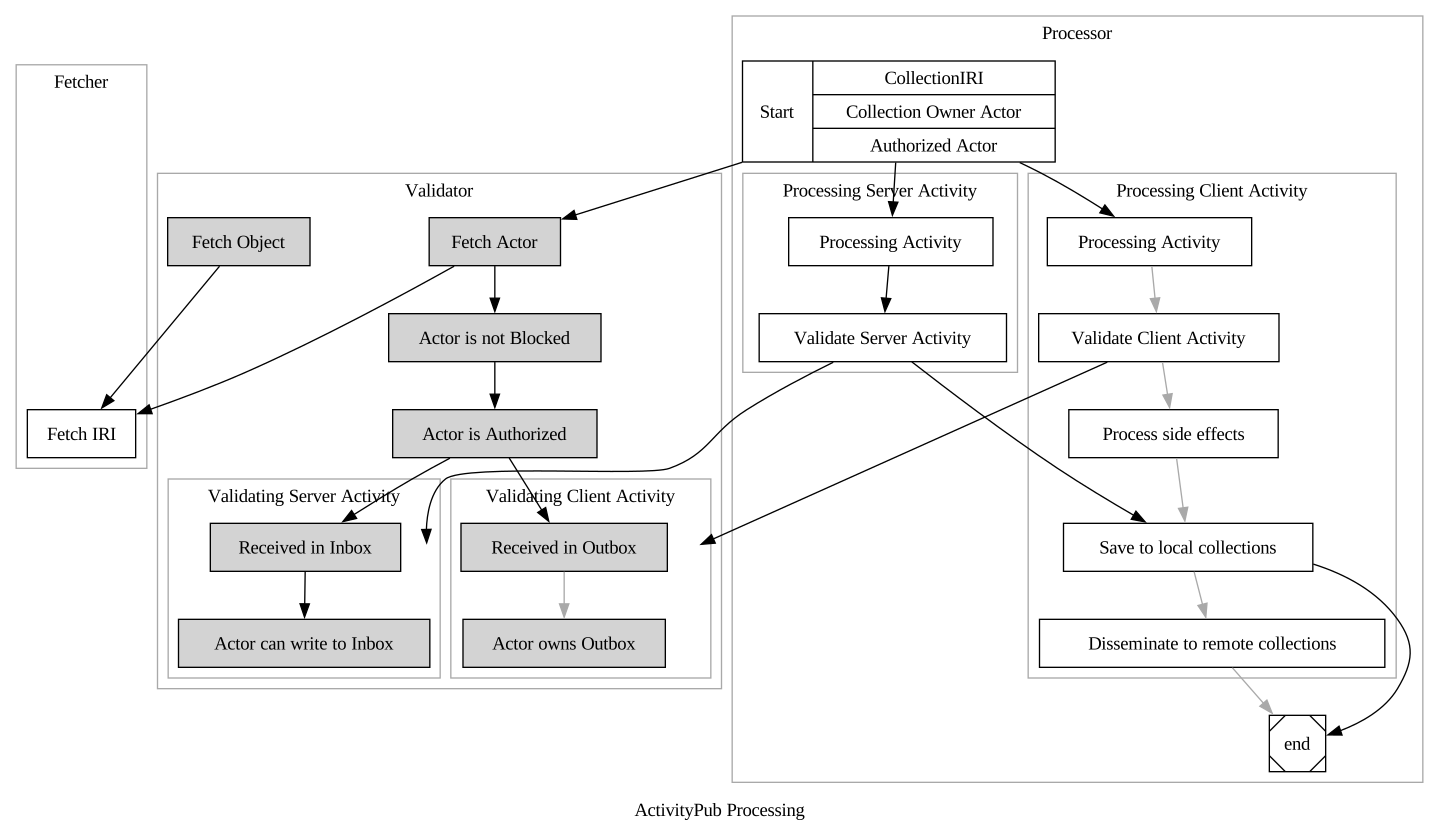
- one for client to server for activities received in outboxes
- one for server to server for activities received in inboxes
// dereferencer is a helper interface that gets used
// by the [Validator] to enrich an activity with additional information.
type dereferencer interface {
	// Add adds the IRIs to the fetch process.
	Add(iri ...vocab.IRI)
	// OnFetched calls fn function with the resulting IRI, Item pair
	OnFetched(fn func(vocab.IRI, vocab.Item))
	// OnFetchError calls fn function with the resulting IRI, error pair
	OnFetchError(fn func(vocab.IRI, error))
}

// disseminator is a helper interface that gets used
// by the [Processor] to submit activities to recipients.
type disseminator interface {
	ToCollection(colIRI vocab.IRI, it vocab.Item) error
}

// readStore is a helper interface that gets used
// by the [Processor] or [Validator] to retrieve
// objects and activities from *local* storage.
type readStore interface {
	Load(iri vocab.IRI, ff ...filters.Check) (vocab.Item, error)
}

// readStore is a helper interface that gets used
// by the [Processor] to save objects and collections to *local* storage.
type writeStore interface {
	// Save saves the incoming ActivityStreams Object, and returns it together with any properties
	// populated by the method's side effects. (eg, Published property can point to the current time, etc.).
	Save(vocab.Item) (vocab.Item, error)
	// Delete deletes completely from storage the ActivityStreams Object, this is usually
	// a side effect of an Undo activity.
	Delete(vocab.Item) error

	// AddTo adds "it" elements to the "col" collection.
	AddTo(vocab.IRI, ...vocab.Item) error
	// RemoveFrom removes "it" item from "col" collection
	RemoveFrom(vocab.IRI, ...vocab.Item) error
}

// store is a helper interface that gets used
// by the [Processor] or [Validator] to retrieve and/or store
// objects and activities from *local* storage.
// It's implemented by individual storage backends.
type store interface {
	readStore
	writeStore
}

type Validator interface {
	// Validate validates an activity.
	// It dereferences all properties that need to be dereferenced and validates it.
	// The "it" parameter gets enriched with the dereferenced properties.
	Validate(ctx context.Context, it vocab.Item) error
}

type Processor interface {
	// Process processes the incoming activity
	// The "it" parameter gets enriched with whichever additional information operating
	// the activity adds.
	// Eg. In the case of a Create activity operated in an outbox collection, its Object
	// would receive an ID, or the Published property gets added if they're missing.
	Process(ctx context.Context, it vocab.Item) error
}
The ActivityPub client
Currently the client module consists of a wrapper for a standard library http.Client which has additional functionality for the ActivityPub specific operations.
Additionally there are http.RoundTripper implementations that are used for authorization in the Social API and with the
We must decide if we want the RoundTripper implementations for s2s and proxy, maybe even debug round trippers should be moved to something else. According to the Go developers cramming this kind of logic into RoundTrippers is not the way.